Bruno Latour is one of the leading figures in Social Sciences today, but his contributions are also widely recognised in the arts. His theories ‘flourished’ in the 1980s in the aftermath of the structuralism wave and generated new concepts and methodologies for the understanding of the social. In the past decade, Latour and his Actor-Network Theory (ANT) have gained popularity among researchers in the field of architecture.
Latour for Architects is the first introduction to the key concepts and ideas of Bruno Latour that are relevant to architects. First, the book discusses...
News & Logs
June 2, 2022
June 2, 2022
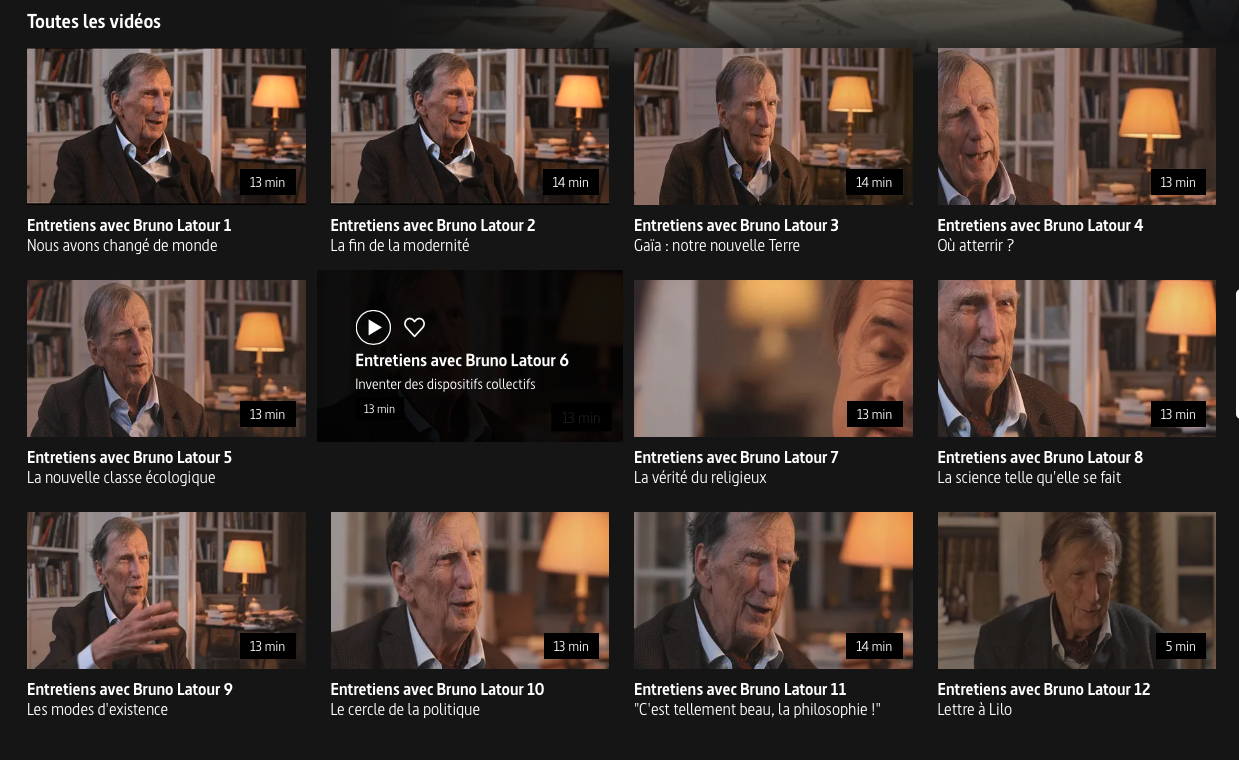
In a highly detailed interview, renowned French philosopher and political scientist Bruno Latour sets out his thoughts on the climate crisis as well as his own philosophy. For the first time the overall logic of his whole career is clearly articulated from early work in STS up to Gaia through the central role of the Modes of existence Inquiry. Accessible by clicking on here
December 26, 2021

Never let a good crisis go to waste
Published in an edited version with a silly title on the 25th of December 2021
There is a moment when a never-ending crisis turns into a way of life. This seems to be the case with the present pandemic. If so, it might be wise to explore the permanent condition in which it has left the polity. One obvious lesson is that societies have to learn once again to live with microbes, just as they had learned to do when those little bugs were made visible by Pasteur’s and Koch’s discoveries.
...
June 22, 2021
Après le prix Holberg en 2013, BL reçoit le très prestigieux prix Kyoto donné par une fondation japonaise. Il a été donné à Paul Ricoeur, Ariane Mnouchkine et Pierre Boulez (pour ce qui est des français). Les deux prix constituent une sorte de Prix Nobel pour les domaines que les Prix Nobel ne couvrent pas.
June 3, 2021
The Critical Zones show is open again for visitors, after having been accessible only through digital means, until January 2021 at ZKM Karlsruhe.
The hypothesis we want to propose is that the best way to map this new Earth is to see it as a network of CRITICAL ZONES. Generated over eons of time by various life forms, these CRITICAL ZONES form a surface only a few kilometers thin. Those life forms had completely transformed the original geology of the Earth, before humanity transformed it yet again over...
June 3, 2021
“How to remain Human in the Wrong Space? A comment on a dialog by Carl Schmitt” Critical Inquiry Vol 47 Summer 2021 pp. 699-718.
To become aware of the depth of the ecological mutation, one has to criticize the notion of abstract space to let it being generated by connections among overlapping life forms. It turns out that in many of his works, Carl Schmitt has found ways to politicize the production of neutral depoliticized space. This is especially true in a not so well known dialog...
November 5, 2020
The streaming can be accessed by Cartier's site on facebook
When I first entered Sarah Sze’s New York studio space in October 2016, I stumbled in the half-light upon one of the huge prototypes for Timekeeper, and I experienced something akin to the awe the Emperor of China must have felt watching Father Matteo Ricci unravel world maps before the court—images of the Earth the foreigner had brought from the distant Western world. “Yes, this is where we live; this is how we should understand...
July 29, 2020
Preface
This book aims at changing the conversation over the many controversies and conflicts triggered by the ecological mutation, by literally, shifting the ground on which it takes place. Like many people, we were worried about the lack of reaction of people who remained indifferent to the global crisis, when we realized that groups of scientists in Earth science, who had coined the word “critical zones” to develop their research project, had in fact, little by little, modified the very definition of the land on which politics take place. After having built, through the...
June 28, 2020
Barbara Kiolbassa convened Bruno Latour and Peter Weibel to explain to the public what is the "terrestrial" as part of the lectures of the Terrestrial University assembled for the duration of the exhibition "Critical Zones -Observatories for Earthly Politics in Karlsruhe ZKM on view until February 2020. The video can be seen here.
June 7, 2020
It would certainly be a shame to lose too quickly all the benefit of what Covid-19 has revealed to be essential. In the midst of the chaos, of the world crisis that is to come, of the grief and suffering, there is at least one thing that everyone has been able to grasp: something is wrong with the economy. First of all, of course, because it seems that it can be suspended in one fell swoop; it no longer has the appearance of an irreversible movement that can neither slow down, nor by any means stop, without risk of catastrophe. Next, because all those in lockdown have noticed that class...
